Solving bubble problems in CIP cleaning lines

CIP-Compatible Bubble Removal
for Beverage Piping

The sanitary Bubble Eliminator continuously separates bubbles entrained in liquids flowing through beverage and food piping. Ferrule connections support CIP cleaning. Materials, pipe size and cleaning conditions are confirmed for each line.

CIP Compatible Sanitary Design Cleaning Conditions Confirmed No Dedicated Power No Moving Parts
Bubble Eliminator unit — CIP-compatible sanitary inline continuous degassing system

Why switch

Common challenges with conventional degassing in CIP lines

Conventional degassing equipment that cannot integrate into CIP lines creates ongoing burdens — disassembly cleaning, hygiene risks, and reduced uptime.

×
Cannot integrate into CIP lines
Conventional degassing requires disassembly cleaning. Non-CIP-compatible units must be removed from the line for every wash cycle.
×
Cleaning residue risks
Filters and mesh trap residue in their gaps, creating hygiene risks and increasing cleaning validation burden.
×
Disassembly & reassembly burden
Time-consuming disassembly cleaning and reassembly of degassing equipment reduces production line uptime.
×
Rising hygiene management costs
Labor for disassembly cleaning, cleaning validation, and parts management accumulate, driving up costs.

Value of switching

Why customers choose the Bubble Eliminator for CIP lines

01
CIP-compatible sanitary type
Ferrule connections support installation in process piping. The cleaning method and need for disassembly are assessed for each liquid and CIP cycle.
02
Simple internal construction
No filters, mesh or moving parts. Cleanability of wetted surfaces is checked against the actual process and cleaning conditions.
03
24/7 continuous operation for quality
During production, the device continuously separates bubbles in the liquid. During cleaning, CIP is carried out under the confirmed line conditions.
04
Food & pharmaceutical grade materials
SUS316L sanitary construction as standard. Also available in SUS304, PVC, and H-PVC to match your process fluid.

How it works

Dual Cyclone Technology — No Dedicated Power

Fluid enters using existing line pressure.
A swirl flow leverages density differences
to concentrate bubbles along the central axis
for continuous removal. No additional power source needed.
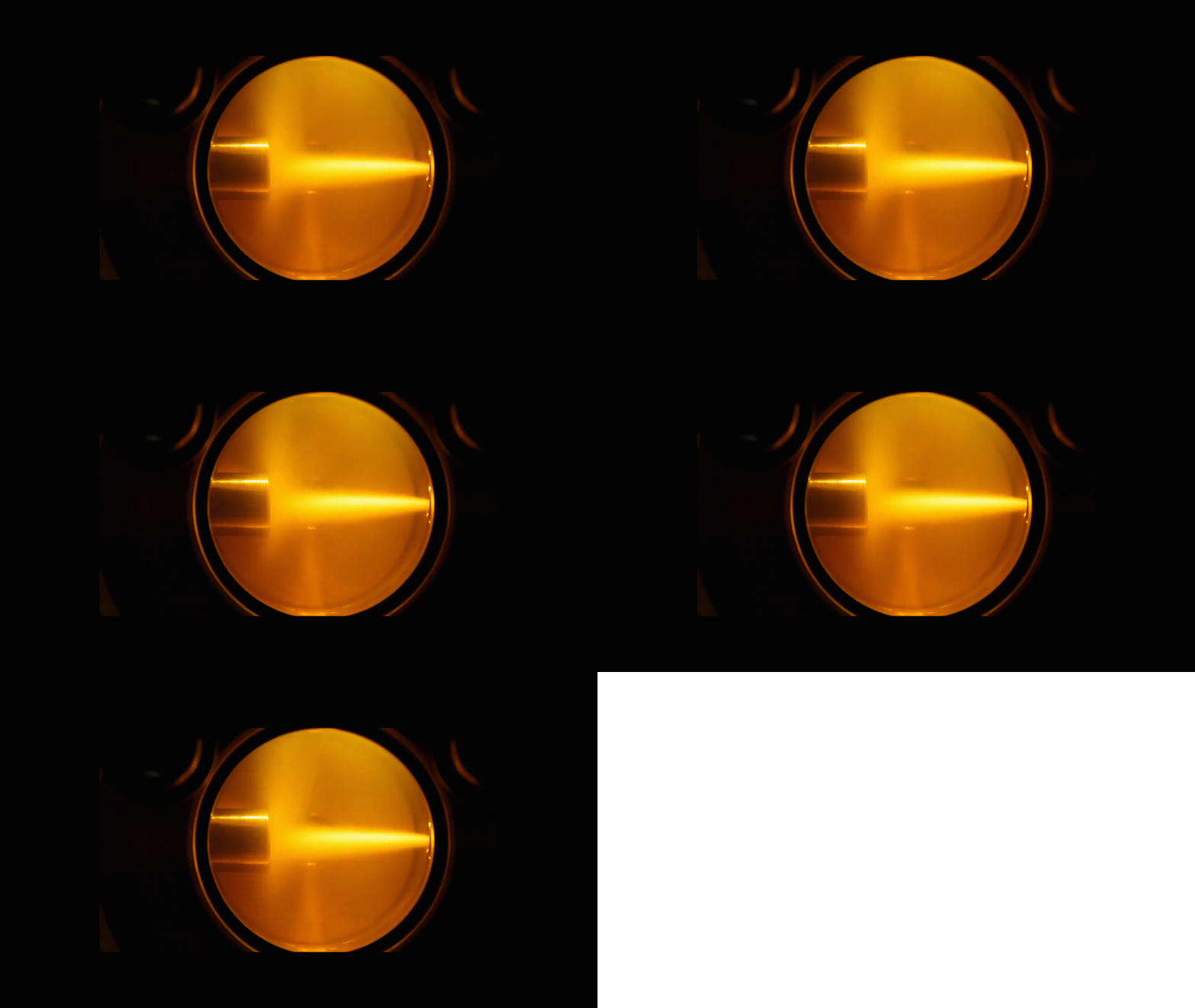
Internal swirl flow separating bubbles inside the Bubble Eliminator
01
Generate swirl flow
Fluid enters under existing line pressure, and a proprietary internal structure generates a high-speed swirl flow.
02
Gas-liquid separation
Density differences between gas and liquid concentrate bubbles along the central axis of the vortex.
03
Continuous removal
Separated bubbles are continuously discharged from the system without interrupting flow.
The result:
no dedicated power,
no consumable parts,
CIP-compatible sanitary options.

Before installation

Selecting CIP-compatible bubble removal for beverage piping

During production, the device separates bubbles entrained in the process liquid. During cleaning, the installed piping and device are intended to undergo CIP. Suitability must be checked for each production and cleaning line.

Process liquid and bubbles
Identify the beverage or ingredient, where bubbles enter the line, and the required flow rate.
Piping and connections
Confirm pipe size, connection type, operating pressure, and available installation space.
CIP conditions
Check cleaning agent, temperature, flow rate, cycle time, and hygiene requirements before choosing wetted materials and the cleaning method.

Review the product specifications and drawings, then discuss your line conditions with us.

Before / After

What changes when you switch

CONVENTIONAL DEGASSING
×Degassing equipment requires disassembly cleaning
×Must remove from CIP line for cleaning
×Filter/mesh residue risks
×Production stops for disassembly & reassembly
×Rising hygiene management workload & costs
BUBBLE ELIMINATOR
✓CIP-compatible sanitary type available
✓Clean in place without removal
✓No filters or mesh in the device
✓24/7 continuous operation, no stoppages
✓Reduced hygiene management workload & costs

Applications

Solving bubble problems
across diverse production lines

Semiconductor wafer cleaning process — precision cleaning with chemical solutions
SEMICONDUCTOR
Semiconductor & electronics cleaning
Removes bubbles from cleaning fluids to prevent adhesion defects and uneven cleaning results.
Coating and surface treatment process — precision liquid application
COATING
Coating & surface treatment
Eliminates bubbles from coating fluids to reduce streaks, pinholes, and surface defects.
Food and beverage filling line — bottle filling process
FOOD & BEVERAGE
Food & beverage filling
Pre-fill degassing stabilizes measurement accuracy and ensures consistent fill quality.
Analytical and measurement instruments — precision measurement equipment
ANALYSIS
Analytical & measurement instruments
Removes bubbles from flow channels to prevent measurement noise and signal disturbances.

* Results may vary depending on operating conditions.

FAQ

Frequently asked questions

The sanitary type (BS-C/BS models) supports CIP cleaning with ferrule connections.
Confirm cleaning conditions for the process line.
The sanitary type is designed for CIP cleaning while installed in the piping. Whether disassembly cleaning is needed depends on the process liquid, cleaning agent, temperature, flow rate and hygiene requirements.
SUS316L, SUS304, SS400 equivalent, PVC, and H-PVC — selected to match your process fluid requirements.
1 L/min and above, with no upper limit on maximum flow rate.
With its low pressure drop, omnidirectional installation, and ferrule connections,
the unit can be spliced into existing CIP lines. Connection ports and configuration are custom-engineered to match your system.
Device configuration, connections, and materials are custom-engineered to match your line,
so standard specifications vary by application. Please contact us for details — we will propose the optimal configuration.

Ready to discuss degassing
for your CIP line?

Tell us about your current system —
method, flow rate, process fluid, and conditions.
We will propose the optimal configuration for your line.